








Products using these materials:
 AcoustiPack™ ULTIMATE
AcoustiPack™ LITE
AcoustiPack™ EXTRA Sheet
AcoustiPack™ EXTRA Foam Blocks
Comparative small and large scale acoustic tests with alternative single-layer PC sound-proofing materials demonstrate that AcoustiPack™ multi-layer materials are more effective and safer, whilst still remaining as thin as possible.
 2-Layer Materials
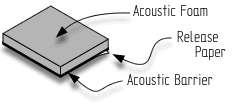 The upper layer, immediately opposite the noise source, is a layer of semi-open cell dense acoustic foam which provides a low-reflection surface. This upper layer of foam provides some sound attenuation, expecially of higher-frequency sound (>1kHz). The very dense black limp 'plastic' layer at the base of the 2-layer material is directly attached to the substrate. This layer acts as both an acoustic barrier (effectively attenuating the transmission of sound energy through the material) and as a damping layer, reducing vibration in the substrate (usually a thin steel panel in many PCs and server enclosures).
The 2-layer materials in the AcoustiPack™ range of kits are 4mm thick. We manufacture thickness greater than 4mm for OEM and manufacturers, but the thickness in the AcoustiPack™ kits is the thinnest we can produce to facilitiate fitting the materials in small and narrow spaces inside modern PC cases.
 3-Layer Materials
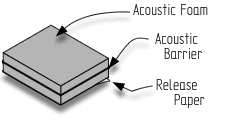 In our latest generation of 3-layer composite (Patent Pending), the dense acoustic barrier layer has been 'suspended' away from the substrate in the centre of the acoustic foam. The construction layering is like this: (noise source) acoustic foam -> acoustic barrier -> acoustic foam (then the substrate, which is usually a metal sheet panel).
Sound energy first hits the upper foam surface, which is similar to the 2-layer construction, in that it is a low-reflective soundproofing material that is particularly effective at absorbing high frequencies. The sound energy then encounters the central suspended barrier layer, which is decoupled from the substrate. This high-density high-mass layer acts as an acoustic barrier mass to the transmission of energy through the material.
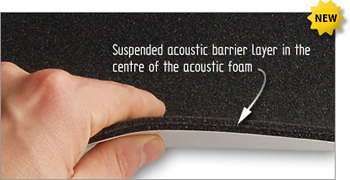 The 3rd layer of foam acts to suspend the barrier layer a small distance away from the substrate. We have found from both small scale impedance tube and larger scale reverberation chamber acoustic tests that the 'suspended' central acoustic barrier effectively increases the absorbtion of low frequency noise (<1kHz). This may well be a result of the 'mass-spring effect', where low frequency energy is absorbed by the sound 'moving' the layer when it is excited by certain resonant frequencies.
The 3-layer materials are attached by a supported self-adhesive directly to the substrate, and have a damping effect on panel vibrations. (Hit the side of your PC once fitted, and you will hear a dull 'thud' sound).
The 3-layer materials in the AcoustiPack™ kit range are 7mm thick. We also manufacture these composites up to 13mm thickness (and over if required ) for manufactures and OEMs. For example, they have been very successfully used in servers and server cabinets, and tested by many different organisations all over the world since they were first developed.
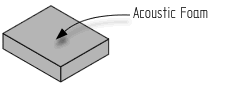 AcoustiPack™ EXTRA Foam Block is precision-cut from a semi-open cell dense but flexible professional-grade polyurethane acoustic foam.
It has a new improved dark grey/black colour, and is non-shedding and does not crumble or generate dust. This acoustic foam is over 60Kg/m³ - which is unusually dense compared to cheaper alternative noise-reduction foams (most are under 30Kg/m³).
The reasons we choose to source such a high-density acoustic foam are:
 The individual components of the multi-layer composites used in AcoustiPack™ sound-proofing kits are certified and UL-listed for low flammabilty.
The finished 2 and 3-layer composites (including the adhesives) have also been tested using a vertical burning flame test, and both 4mm and 7mm materials meet class UL94-V0. The acoustic foam is certified to the highest appropriate UL94 specification for a foamed product (UL94 HF1) for low flammability.
These low flammability results more than satisfy BS EN 60950-1:2002 'Information Technology Equipment - Safety' section 4.7 with respect to resistance to fire for materials inside fire enclosures.
You may like to check that alternative sound proofing materials also meet these stringent standards!
 The foam is RoHS certified. RoHS restricts the use of six substances to within specified limits (Lead Pb, Cadmium Cd, Mercury Hg, Hexavalent Chromium Cr+6, Polybrominated biphenyls PBB and Polybrominated diphenyl ethers PBDEs/PBBEs) within Electrical and Electronic Equipment (often referred to as EEE), thereby contributing to the protection of human health and the environment.
The foam material is suitable for use in indoor environments within the temperature range -40°C to +100°C, which is in excess of those typically suitable for IT equipment.
Home | About | Solutions | News | Sitemap | Terms | Privacy | Contact
Acousti Products is a division of The Rack People™, a company registered in England & Wales
No. 04514007. Registered Office: Lifford Hall, Lifford Lane, Kings
Norton, Birmingham, B30 3JN UK (previously named Acousti Products Ltd
- change of name May 2013).
All Rights Reserved. Graphics and
content ©2013 The Rack People™
 Callback
 Message
 Online Demo